Sometimes the hardest part for a homeowner who wants a barn quilt is deciding where it will be hung, what size is right for the spot, and finally which pattern fits best for their property’s story. Once all of those things are determined….the building of the board begins.
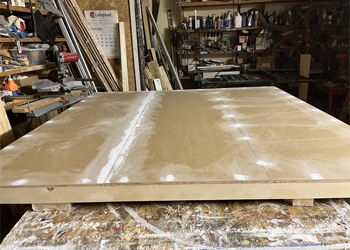
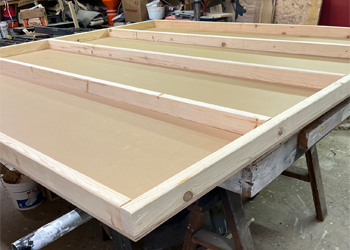
Almost all of Frankenmuth Area Barn Quilts are made with ½” MDO although, other options are available such as ACM. Our materials are always purchased from a local lumber yard. If the quilt is 4’ x 4’ or larger, 2 x 4’s are used for the frame and support. Screws are used for framing and attaching the MDO to the frame.
We cut the MDO to the size of the barn quilt, if the quilt is bigger than 4’ x 4’ another piece is cut for the length and width needed. The frame is built by cutting 2’ x 4’ s to the right length. Screw the pre-drilled corners together and put the bracing inside of the frame at 2ft on center or where the seam falls depending on the size. The MDO is then attached to the frame. The frame and MDO are squared up, and we begin to drill holes for the screws using a counter sinking bit. Holes are drilled about 8” apart around the frame making sure it is square, next we put in the first screw to hold it in place.
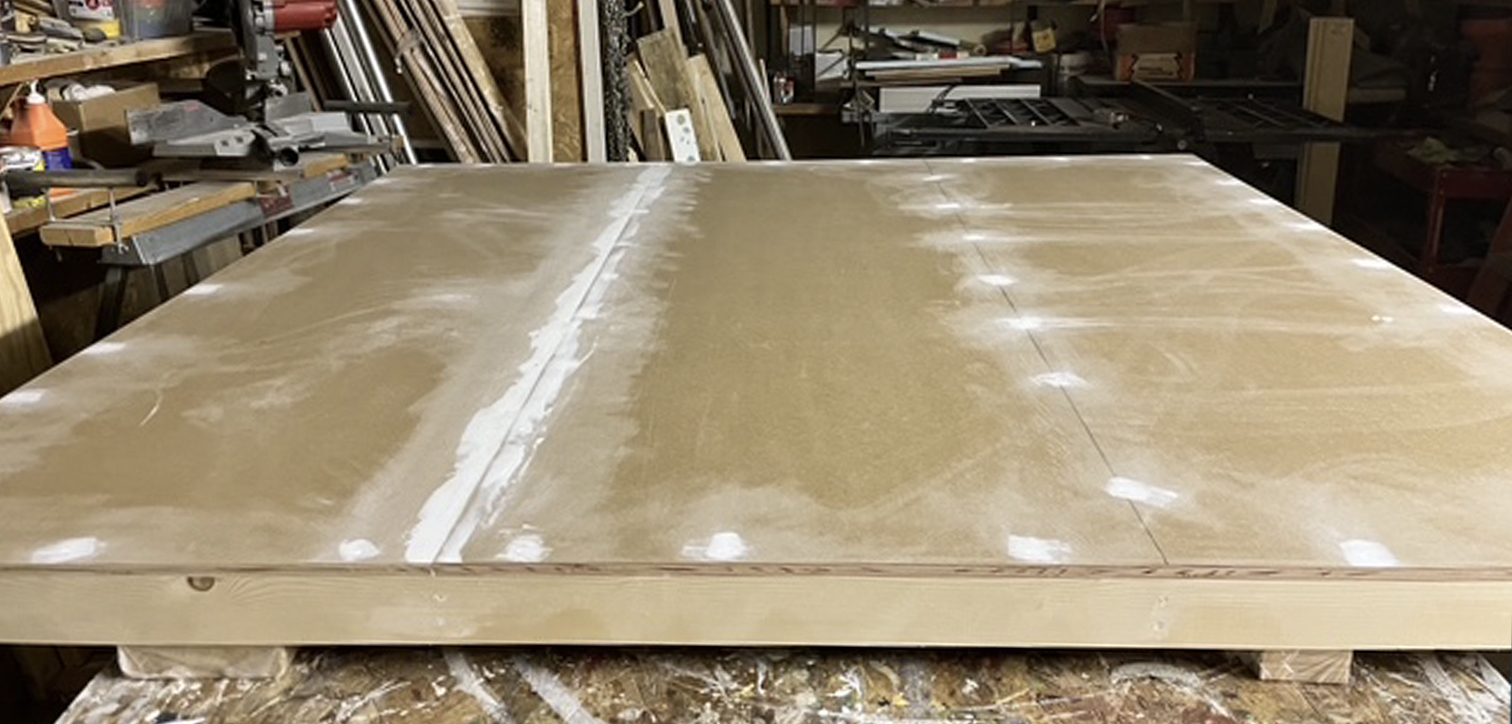
After all screws are in, each hole is filled with a wood filler making sure they are filled to the top. Once dry sand and repeat the process with wood filler. We check the sides of the MDO for any voids and fill those as well.
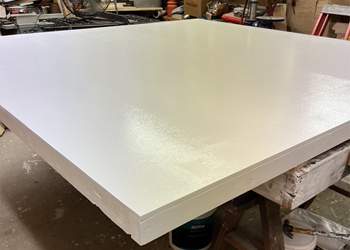
When the filler is dry and all holes and voids are filled, it is time to paint. A roller is used to apply 2-3 coats of Kilz 2 primer, ensuring that all coats are even and cover well. The frame and both sides of the barn quilt are painted. All wood is painted as these are typically hung outside and need protection from the weather. Once the primer is dry, a high-quality exterior paint is applied to all of the wood. Using exterior paint eliminates the need for any sealer on the barn quilt as sealer tends to yellow in the sun and/or peels off in time.
Paint is allowed to dry for 2 days and then it is time to draw the pattern on the top. Whether the design is painted by someone at FABQ or the owner, it is time to start taping off the first sections on the board for paint.
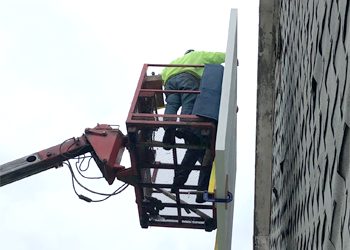
After the barn quilt is built, painted, and finished, eye bolts are added on the top for lifting.
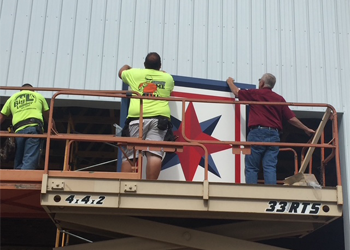
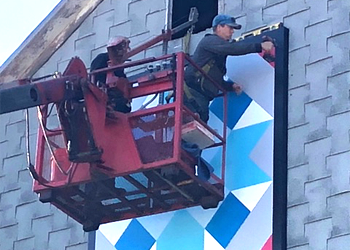
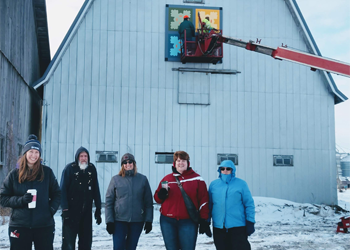
FABQ does not personally hang the barn quilts, sign companies are typically hired to lift the quilt in place and attach it to the barn or building. Once the exact spot is found, holes are pre-drilled and lag screws are used to secure the quilt to the structure.
If built, painted and hung correctly, the barn quilts will stay in place and look beautiful for the homeowner, visitors and passerby’s to enjoy for years!
Catch a glimpse of what the process looks like.
Frankenmuth Area Barn Quilts was formed in 2018 by a group of artisans excited to showcase the beautiful and timeless art form of barn quilts in the Frankenmuth, Michigan area by way of a Barn Quilt Trail. The territory was expanded into Saginaw County where no trail existed.
To pique interest in the art form, classes were offered to learn how to paint a 2x2 barn quilt. The classes have become wildly popular and a few barn quilts on the trail were inspired by these classes. We hope to gain more barn quilts, 4’x4’ or larger, to our already existing 30+ Barn Quilt Trail that is now in place in Saginaw County.
Barn quilts are large, colorful wooden panels painted with quilt block patterns and displayed on barns, homes, and other buildings. Although they resemble fabric quilts, they are made from wood and serve as public art.
The modern barn quilt movement began in 2001 in Adams County, Ohio. The project was started by Donna Sue Groves, who wanted to honor her mother, an avid quilter, by placing a quilt block on their family's tobacco barn. Community members embraced the idea, and it quickly expanded into organized Barn Quilt Trails, where visitors can drive through rural areas to see dozens or even hundreds of unique designs. Today, barn quilts can be found across most U.S. states and parts of Canada.
Barn quilts are meaningful because they:
© © Frankenmuth Area Barn Quilts | Website by Premier Promotions.